Don’t mask your symptoms…treat them! Our goal is to identify and treat the root cause of your symptoms so that you can say goodbye to allergy symptoms. We also provide allergy testing and treatment for kids so your little ones can receive proper allergy treatment.
Allergic Reactions
Respiratory Allergies
Skin Allergies
Gastrointestinal Allergies
Allergic Headaches
Throat and Ear Allergies
Other AllergiesWe offer a comprehensive solution to identify and treat your allergies.
Our approach includes a range of advanced testing methods to pinpoint the root cause of your allergies, followed by a personalised treatment plan tailored specifically to your needs.
See the table below to discover what makes us different.
| Service Provided | Pathology Clinic | Other Allergy Clinic | Allergy Testing |
|---|---|---|---|
| Skin Prick Testing | Yes | Yes | Yes |
| Patch Testing | Yes | Yes | Yes |
| Serial Titration | No | No | Yes |
| Blood Testing | Yes | Yes | Yes |
| Tailored Allergy test | No | No | Yes |
| Allergy Treatment | No | Maybe | Yes |
| Sublingual Immunotherapy | No | No | Yes |
| Management programme | No | Maybe | Yes |
| Physician consultation | No | Yes | Yes |
| Over 100 different types of allergens tested | No | No | Yes |
| Individualised treatment | No | No | Yes |
| Links to biologics trials | No | Maybe | Yes |
| Allergen immunotherapy | No | Maybe | Yes |
| Fully trained allergy nurse staff | No | Yes | Yes |
| Service Provided | Pathology Clinic | Other Allergy Clinic | Allergy Testing |
|---|---|---|---|
| Skin Prick Testing | Yes | Yes | Yes |
| Patch Testing | Yes | Yes | Yes |
| Serial Titration | No | No | Yes |
| Blood Testing | Yes | Yes | Yes |
| Tailored Allergy test | No | No | Yes |
| Allergy Treatment | No | No | Yes |
| Sublingual Immunotherapy | No | No | Yes |
| Management programme | No | No | Yes |
| Physician consultation | No | Yes | Yes |
| Over 100 different types of allergens tested | No | No | Yes |
| Individualised treatment | No | No | Yes |
| Links to biologics trials | No | No | Yes |
| Allergen immunotherapy | No | No | Yes |
| Fully trained allergy nurse staff | No | Yes | Yes |
Allergic Reactions
Respiratory Allergies
Skin Allergies
Gastrointestinal Allergies
Allergic Headaches
Throat and Ear Allergies
Other AllergiesWant to test your allergy?Book an appointment in our clinic
Dr Baker graduated from the University of New South Wales Medical School in 1972 and subsequently was trained in the United States by leading allergists including Dr French Hansel who is often regarded as the father of Ear Nose and Throat allergy. Read more about Dr Richard Baker here.
Allergic Reactions
Respiratory Allergies
Skin Allergies
Gastrointestinal Allergies
Allergic Headaches
Throat and Ear Allergies
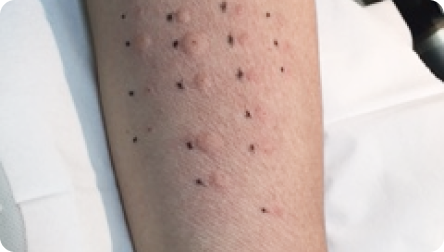
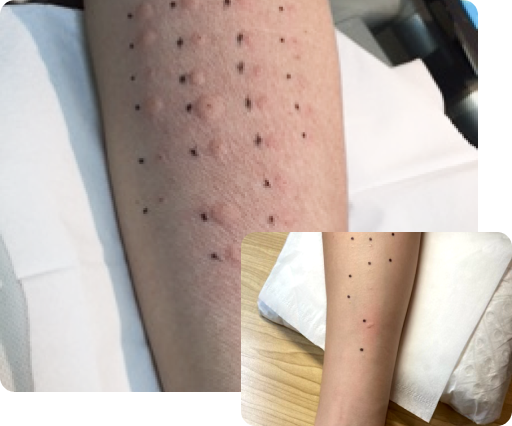
Other AllergiesThe skin prick test is a routine test performed by allergists. It involves placing small amounts of allergens onto the skin then with a small lancet a superficial break in the skin is made. The test is monitored for 15 minutes and observed for any signs of a wheal or flare reaction. The skin prick test is low risk and delivers quick results for the doctor to gain an indication of each patient’s sensitivity.
After an initial consultation, Dr Baker determines which allergens to test. The test will span over 40 allergens on your first appointment, with foods and inhalants extensively tested at no extra cost.

Dr Baker’s preferred method of treatment is immunotherapy with a sublingual vaccine that is made on the premises and prescribed specifically for each patient. The treatment costs less than $1 a day and targets the allergens causing the patients sensitivity through a desensitising process.In order for the vaccine to be prescribed Dr Baker performs a second set of tests involving intradermal testing using very weak dilutions of the specific allergen in order in order to determine a safe and effective starting dose for each patient.
The test involves injecting small amounts of diluted allergen extracts just under the skin. After waiting ten minutes, the skin is examined for a reaction. This procedure can be repeated using two to three dilutions of the same extracts, getting subsequently stronger or weaker each time. Once the patients skin reacts positively to a particular allergen(s), the test is complete and a vaccine can be made to desensitise against the allergens causing the patient problems.
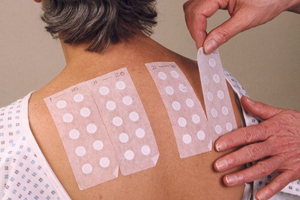
This test is performed in cases of contact dermatitis (Eczema) or any other allergy is suspected. The allergens are prepared in appropriate concentrations in white soft paraffin (e.g. Vaseline) and are then spread on to discs, 1 cm diameter. The discs (which are made of a special metal, cannot themselves provoke a reaction) are placed on the skin, usually on the back, and are kept in place by hypoallergenic tape. The skin is coded appropriately and the patient is asked to keep the skin dry. The patches are left in place for 48 hours.
After 48 hours the discs are removed, the skin is examined and any redness or swellings are noted. The skin is re-examined after a further 48 hours for any remaining local redness or swelling. The interpretation of this form of testing is not as simple as it sounds and tends to be carried out by a doctor. The symptoms of contact dermatitis need to be brought under control before patch testing can be carried out, otherwise the results will be unreliable. Steroid creams need to be stopped for 3-4 weeks before testing as they may suppress the test response. Any professional interpreting skin, blood or patch tests must first interpret the results in the light of the patient’s history. No test should be read in isolation.

Despite continuing advances in the diagnosis of immunoglobulin E (IgE) mediated inhalant and food allergy utilizing in vitro technology, the otolaryngic allergist should be familiar with the principles and practise of skin endpoint titration (SET). Skin testing techniques and responses will allow proper interpretation of in vitro-based antigen vial tests, will permit the blending of in vitro and in vivo test methods within the allergy practice, and will often give a clearer picture when a practitioner is caught in a confusing situation. Preparing to do a skin Endpoint Titration Test is time consuming and labour intensive requiring a trained scientific officer or doctor to perform the tests. A immunotherapy dosage for either injection or sub-lingual vaccine can be better determined using this method.
We partner with you to stop your allergic reactions. Train your body to tolerate your allergies with clinically backed treatments made for you.
With our sublingual immunotherapy you can treat your allergies from the convenience of your home
Our office is designed for maximum efficiency, safety, comfort and functionality.
Our goal is to empower you with cutting-edge scientific information, and together, make a treatment plan that fits your lifestyle and budget.
Avoid fragrances, stop certain medications as directed before your appointment to ensure accurate testing, and please inform the nursing staff if you are taking beta-blockers or tricyclic antidepressants. Also, refrain from using specific nasal sprays a week before testing.
On allergy testing day, the doctor will assess your history and choose allergens to test. The nurse, supervised by the doctor, will conduct the tests. Based on the initial results, further testing may be done the next day to gauge your sensitivity, depending on your chosen treatment with the doctor.
After your initial consultation, you'll undergo testing for inhalant and food allergies that the doctor suspects could be the cause of your allergy. We use both forearms to test for multiple allergens, aiming to obtain a comprehensive understanding of your allergic condition.
We provide immunotherapy and educate our patients on allergy-free living. We offer two types of immunotherapy: custom sublingual vaccines tailored to your sensitivity and injections administered under doctor supervision to gradually desensitize you to allergens. Unlike costly over-the-counter options, our sublingual vaccines are tailored and effective.
We'll schedule a follow-up appointment six months after starting treatment to assess your progress. Regular testing every six months will help strengthen your immunotherapy until your allergic symptoms improve.
Following the work of his father Dr. Stephen Baker, an ear, nose and throat surgeon, Richard helped pioneer ear nose and throat allergy in Australia. He treats all allergic conditions and has an on-site skin testing clinic. Richard is also a member of the ASCIA
Qualified and Dedicated Medical Professional
Allergy testing identifies allergens that cause allergies. If allergies are not treated they can often get worse and weaken your immune system and set you up for dangerous complications such as bacterial or fungal infections in the sinuses, lungs, ears or skin. Testing for allergies is particularly important in children to ensure that more chronic conditions do not develop from untreated allergies.
Most allergic tests involve minimal discomfort. Skin prick tests may cause slight itching or a pricking sensation, but it’s generally tolerable.
Most of your results will be determined on the day of your test. If not the first day by the second appointment. If Dr Baker prescribes a blood test this can take longer.
There can often be delayed reactions which are relevant. These are monitered by our team.
We are a Medicare Accredited Medical Practice.
Immunotherapy by injection is covered by medicare. Some private insurance companies cover the sublingual vaccine costs.
We treat everything from allergies to tonsilitis – for the full list click here
Visit us L7 William Bland Centre 229 Macquarie Street Sydney, NSW, 2000
Call us on (02) 9221 1511